The Essence of Relatedness
In western civilisation the conventional traditions of thought we are inclined towards describing our world as an existing space filled with an unfathomable number of independent objects, us in the midst of it as perceiving subjects. As a rule the religious systems of the Occident project an additional godhead who, in contrast to the concepts found in eastern religions, leads an existence beyond the realm of material objects.
Dissociating particular aspects from the context of the world in this manner as well as conceiving them as autonomous entities established the basis for a categorization of the objects and phenomena our reality consists of in perpetually increasing detail, a process which has been proceeding since antiquity and whom we owe modern western science to. In our everyday thinking this tradition most of all reveals itself in the general distinctions we make. Humans are separated from animals, nature from culture, art from science, mind from body, knowledge from faith, form from content, the explicable from the inexplicable.
But this reliable dissection of reality into consumable units has now for some time increasingly been experiencing reversals. In his work German writer Novalis, whose education encompassed Johann Gottlieb Fichte’s philosophy of self and non-self, not only attempted to transcend the limit between subject and object, but, in bold anticipation, stated that ‘geometry is the transcendental art of drawing’ and ‘pure mathematics is religion’.
Over the course of the past century even physics has increasingly come to oppose the dissection of reality, seeking to establish unifying formula. While Newton’s concept of reality, which consisted of space, time and particles, was extended by Maxwell and Farady, who introduced fields in middle of the 19th century, Einstein unified space and time employing a breathtaking theory, thus exposing the relative nature of formerly absolute parameters such as velocity.
Later quantum mechanics unified fields and particles to form quantum fields. The most recent offspring of theoretical physics, loop quantum gravitation, eventually postulates a world consisting of only one elementary ingredient – covariant quantum fields, which unify quantum fields and space-time. All appearances we have learned to differentiate – space, matter and even time – are therefore purely emergent, i. e. secondary phenomena spawned by covariant quantum fields.
With regard to this aspect these hypotheses of contemporary physics, defying everyday common sense, astonishingly converge with the ideas of the pre-Socratic philosophers, who were subsequently largely and unfairly discarded by Plato. Already in the 6th century B.C. Anaximander perceived ἄπειρον (apeiron), ‘the limitless’, as the primal stuff the cosmos consists of. Involved in a permanent balancing process all appearances emerge from it, eventually to dissolve into it again. The distinctions we make among the appearances emerging from the limitless, are thus illusions.
With Parmenides, who formulated it more forcefully, this concept reoccured approximately one century later. In his educational poem ‘About Nature’ he describes how Dike, the godess of justice, reveals that τα εoντα (ta eonta), the existing, exists. On the other hand, μη εoντα (mê eonta), the non-existing, does not exist. What may appear banal at first sight becomes tricky as soon as you realise that the non-existing exists nowhere, that there exists no place where the existing is interrupted, and that there thus are no separations between appearances. Hence the world cannot be conceived of a unity of many things. It is one thing – oneness.
This unique existence, the goddess continues to explain, has neither origin nor decline, it exists beyond time while it is indivisible, it cannot be located while it is here, now and at the same time. It excludes all chronological categories. It is this absence of temporality that in a baffling manner corresponds to the description of a reality void of time as described by the theory of loop quantum gravity.
Moreover Parmenides states that oneness is neither observable nor conceivable. This proposition in turn corresponds to a witticism ascribed to Heisenberg reading that any person claiming to have understood quantum theory without having gone insane could not have understood it, as it is incomprehensible, inconceivable. Parmenides, though, concedes that, while solitary existence may be inconceivable, it would still remain thinkable.
As already Novalis considered the separation between science and religion an illusion, just like the separation between the self and the non-self, subject and object, Wahida Azhari also perceives the traditionally presupposed limits between the fine arts, science and religion as obsolete, thus rendering art an equally suitable medium for approaching the oneness that otherwise mysticism and the scientific search for the Theory of Everything lay claim to.
An important event in her biography as an artist was overcoming the notion of a central perspective. Attempting to capture a surprisingly intense impression of a rape field, Azhari spontaneously took to working on two sketch books at the same time: the completeness of the impression that can only be experienced as a continuum by turning your head several times and joining the sequentially perceived impressions to form an entity in your imagination made it impossible to apply perspective conventions based on the illusion of a singular point of view. But the process of constructing an inner image consisting of disparate impressions is not only accounted for by a shifting perspective. Even in a static observation our brain is permanently occupied with coordinating the diverging information supplied by two sources of reference – the left and the right eye – as well as harmonising this information.
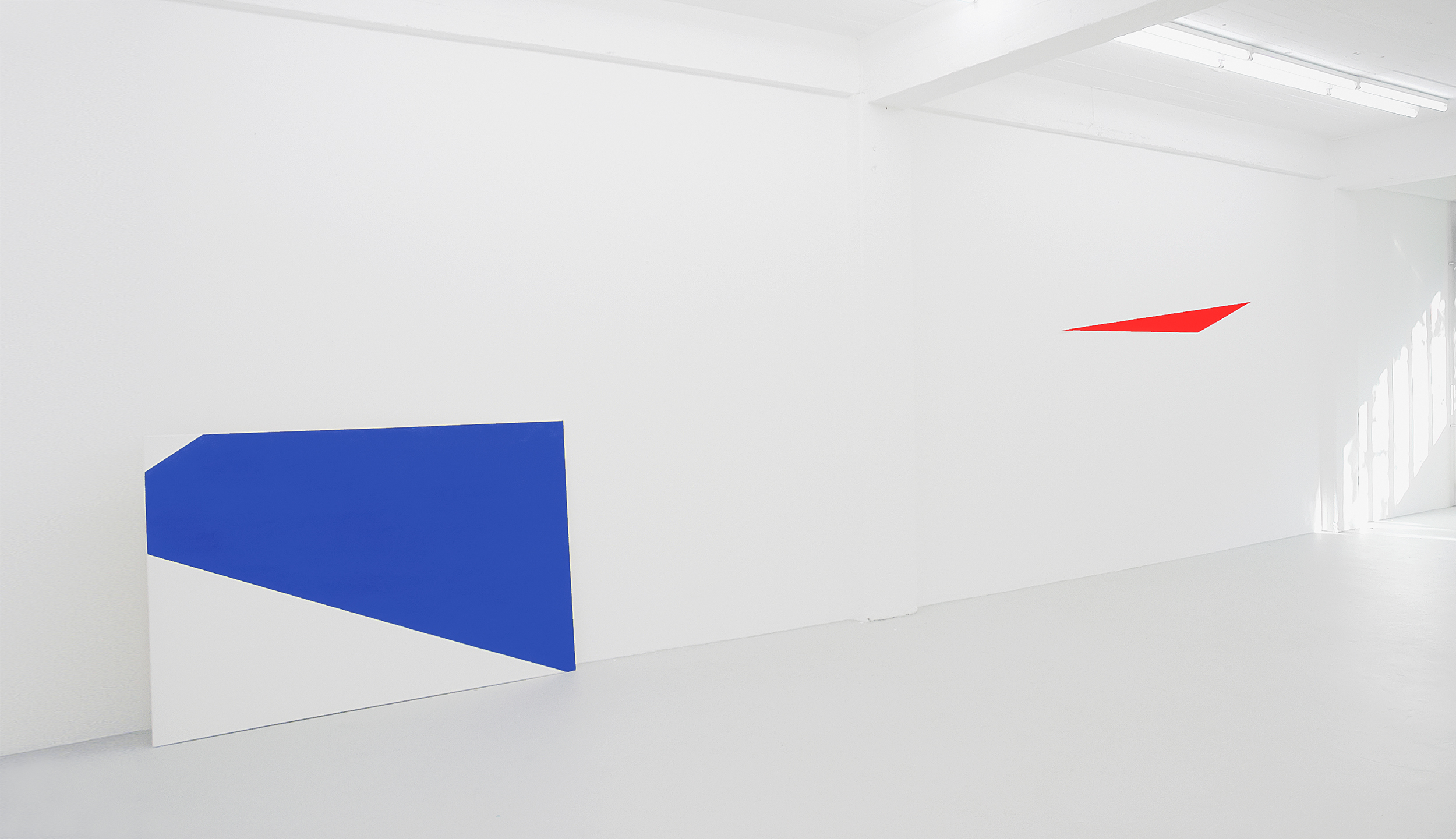
This event introduced the relatedness of elements that would at first sight appear disparate to Azhari’s work. Only the interplay of diverging information can yield a notion of greater relatedness. This notion, on the other hand, occurs somewhere in between, initially conceived of as an empty space.
The interacting elements in Ahhari’s work can be both pictorial objects, lines and colour fields, and the created objects on one hand, and the surrounding space on the other. The development of the individual elements is preceded by an intense process of exploring spatial tensions. Perceived structures are realised by means of small yet essential sections of the spatial vectors in effect.
Once an initial form has been created it serves as the starting point for developing a second one. Eventually their interplay not only condenses the tension in the space, it also establishes a balance between the forces in effect – silence, emptiness – revealing elementary relations. The constellations are thus never absolute or final, and they always correspond with the surrounding space.
In the reception of the dialogue of elements the arrangement of the exhibition is composed of, it is the assumed void between these entities, which once again is assigned eminent significance. Here the essential interconnection of line, colour field and space becomes perceivable; simultaneously the void itself is actually created by the individual elements; it emerges like space emerges in the concept of loop quantum gravity, like silence emerges in music, an element, which Miles Davis claimed to be more important than the sounding notes.
With this event within a supposedly empty space created and explored by the figurative elements, in which the nature of the work by means of observation eventually can unfold and form something superordinate, the pre-Socratic idea stating the non-existence of the non-existent is confirmed, as is the concept of the boundlessness of the existing, the apeiron.
Just as there is no void between the elements as described by the idea of the non-existent, neither is there any boundary between recipient and work, as the relatedness of the elements of the work among each other and with space only become factual in the perception of the recipient. By seeking the greater context the figurative elements are a part of, we simultaneously establish this context. Thus the context not only occurs in the space between the elements of the work, but also in the space between the work and the observer.
Applying to both the process of creating the work and its reception, this conditionality corresponds to a phenomenon known from quantum physics: as long as an event is not observed it is in a condition, in which several possible outcomes, several latent realities are superimposed. Only when the observer appears on the scene he or she actually creates the factual event by means of observation or measurement. The observer and the observed object are just two interrelated aspects of an undivided, indivisible unity.
In the words of Anaximander this unity is the apeiron, out of which apparently separate things have arisen and into which they will merge once again. By sensing their greater framework of interrelationship and perceiving ourselves as tertium quid, as an inseparable component of this system, we can approach oneness – the essence of all relatedness. / Dr. Thomas J. Piesbergen /